Transfer Pricing Practice Management: Roles, Permissions and Oversight for CA Firms Running Multiple Engagements
CA Mithilesh Reddy
17 Oct 2026 · 5 min read
On this page
Direct answer
Running one transfer pricing engagement defensibly is a workflow question - the sequence of stages and sign-offs an illustrative walkthrough already covers in detail. Running forty engagements at once, across a team of analysts, managers and partners, with different clients on different jurisdictions and different filing deadlines, is a different problem: a practice-management problem of who can see what, who can approve what, and how a partner maintains genuine oversight across a portfolio without personally re-checking every file. TAIGA’s team workflow and roles module is built to answer this second, firm-level question, not only the first, single-engagement one.
What this guide covers
This article is written for chartered accountancy firm partners and practice leads evaluating how a transfer pricing platform behaves once it is holding an entire portfolio of client engagements, not just one demonstration file. It covers role-based access, how a firm maintains oversight without becoming a bottleneck, and what capacity visibility across a team should actually look like.
Why single-engagement workflow and firm-wide practice management are different problems
A well-designed single-engagement workflow ensures one file moves correctly from intake to sign-off. A well-designed practice-management layer ensures a partner can answer, at any point, questions that span the whole portfolio: which engagements are currently awaiting reviewer sign-off, which analyst is carrying the heaviest current caseload, which clients have an upcoming filing deadline with an engagement that has not yet reached benchmarking, and which files have been sitting in a review queue longer than the firm’s own internal service standard allows. None of these questions can be answered by looking at any single engagement’s workflow state - they require a view across all of them simultaneously, structured consistently enough that the answers are comparable across files.
Role-based access as a genuine control, not a cosmetic setting
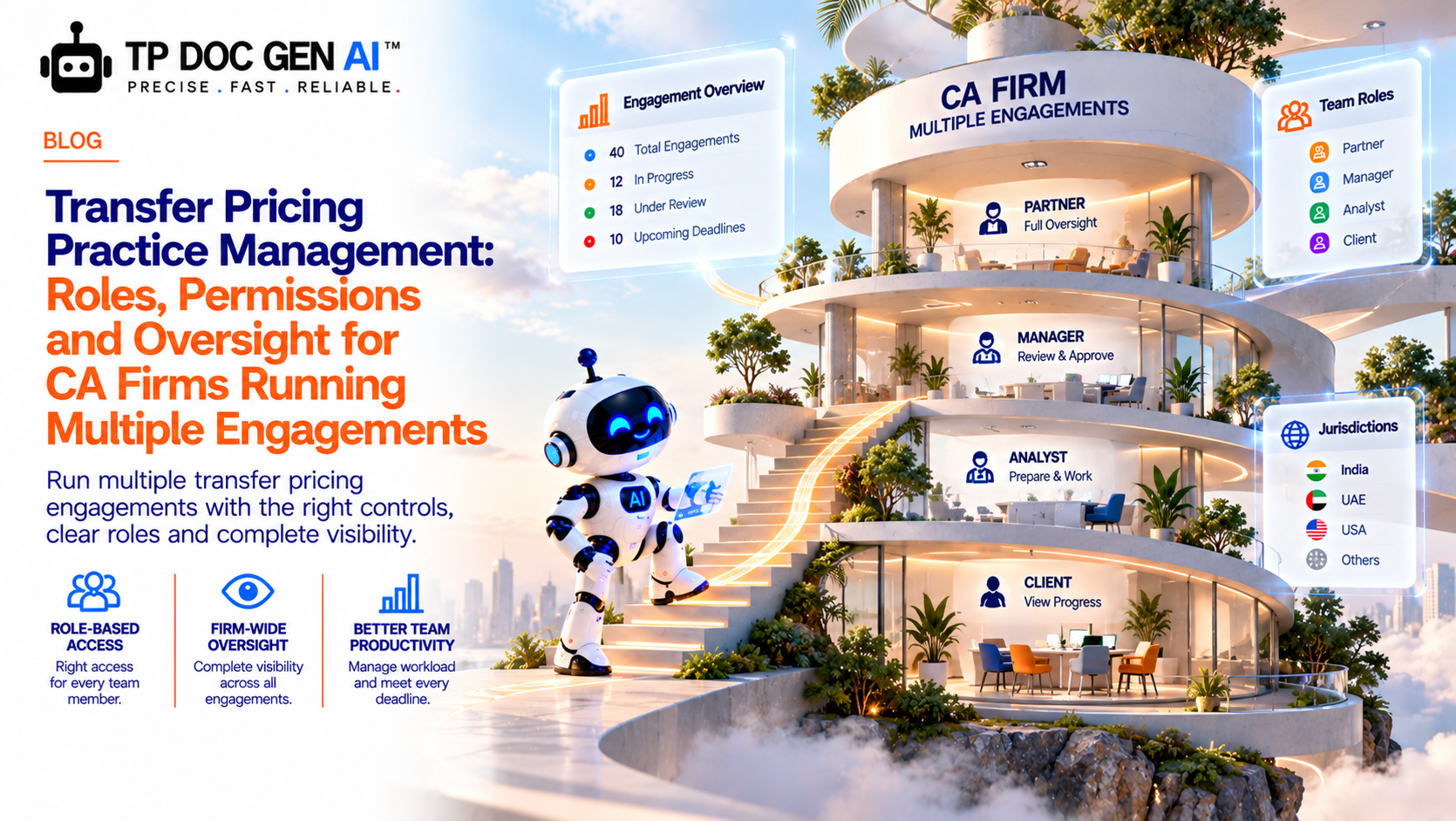
TAIGA’s role structure separates what a preparer, a reviewer, a practice manager and a client-facing user can each see and do. A preparer working a specific client’s engagement has full access to that file’s FAR ratings, comparable search and drafting tools, but does not have sign-off authority - that sits with a designated reviewer, consistent with the second-reviewer principle already built into the engagement workflow itself. A practice manager or partner role sits above individual engagements, with visibility into status and workload across the whole portfolio without necessarily having working access to every client’s underlying data - a distinction that matters for firms managing confidentiality boundaries between engagement teams working on different clients within the same practice. A client-facing user role, separately, can see the status of their own engagement and respond to outstanding information requests without any visibility into the firm’s internal working papers or other clients’ files.
What genuine oversight looks like without becoming a bottleneck
A common failure mode in firms scaling their transfer pricing practice is that oversight becomes entirely dependent on one senior partner personally reviewing every file before it can be filed - a structure that works at small volume and becomes an unavoidable bottleneck as engagement count grows, regardless of how capable that partner is. TAIGA’s structure instead distributes sign-off authority across qualified reviewers while giving practice leadership a portfolio-level view: which files are currently with which reviewer, how long each has been in the review queue, and which engagements are approaching their filing deadline without yet having reached that stage. This lets a partner exercise oversight through visibility and exception-based intervention - stepping in specifically where a file is stalled or a deadline is at risk - rather than through personally re-performing every review, which does not scale past a small handful of concurrent engagements.
Capacity planning across a team, not just status tracking
Beyond status visibility, a practice-management layer that tracks which analyst is assigned to which engagements, and how many are currently active per person, gives a practice lead the information needed to make a capacity decision before it becomes an emergency - reassigning a new engagement away from an analyst who is already carrying an unusually heavy load, or flagging early that a particular filing season’s engagement volume will exceed the team’s current capacity at the pace individual files are moving. This is a distinct benefit from the workflow structure itself: it is not about any one file moving correctly, but about a firm’s leadership having enough visibility across all its files simultaneously to make a staffing decision before a deadline forces a rushed one.
How this differs for a solo practitioner versus a fifty-person practice
The practice-management structure described above is not equally relevant at every firm size, and it is worth being direct about where the benefit actually starts to matter. A solo practitioner or a two-partner firm running a handful of transfer pricing engagements a year can reasonably hold portfolio status in their own memory, checking each file individually without needing a dedicated oversight layer - the coordination cost of doing so manually is genuinely low at that scale. The calculus changes as a firm grows past the point where one person can hold current status on every engagement without a shared system: a twenty-person transfer pricing team running eighty concurrent engagements across several partners cannot rely on any individual’s memory of where each file stands, and the absence of a portfolio-level view at that scale is not merely inconvenient, it is the specific condition under which deadlines get missed and reviewer bottlenecks form. A firm evaluating practice-management capability should honestly assess which side of this scale threshold it currently sits on, and, more usefully, where its engagement volume is heading over the next two to three years, since building this structure in before it becomes urgent is considerably less disruptive than retrofitting it once a bottleneck has already caused a missed deadline.
Bringing a new hire into an existing portfolio
A related, practical benefit of role-based practice management shows up specifically when a firm hires a new analyst mid-year, into a team already running a full portfolio of active client engagements. Rather than a new hire needing informal explanation of “which clients are with which reviewer” and “what stage everything is currently at” - knowledge that otherwise exists only in a manager’s head or scattered across email threads - a structured practice-management layer lets a new team member be assigned specific engagements with the same role permissions any other preparer holds, and see the current status of those engagements immediately, without depending on a colleague’s availability to explain the portfolio verbally. This connects directly to the firm-wide precedent bank covered separately: a new analyst benefits from both a structured view of current engagement status and a searchable record of the firm’s past reasoning, rather than needing either to be explained informally by someone senior enough to remember it.
Role structure at a glance
| Role | What they can do | What they typically cannot do |
|---|---|---|
| Preparer | Full working access to an assigned engagement’s FAR, benchmarking and drafting | Sign off and finalise the file for filing |
| Reviewer | Independent review and sign-off authority on assigned engagements | Bypass the review stage on their own prepared work |
| Practice manager / partner | Portfolio-level visibility into status, workload and deadlines across engagements | Necessarily hold full working access to every client’s underlying data by default |
| Client-facing user | View their own engagement’s status; respond to outstanding information requests | View internal working papers or other clients’ engagement data |
This structure sits on top of the same second-reviewer sign-off principle that governs any single engagement - the difference at practice-management scale is giving firm leadership a genuine, portfolio-wide view rather than requiring them to open each file individually to find the same information. See the full platform overview or book a walkthrough structured around your own firm’s current engagement volume and team size.
Separating oversight visibility from working access, deliberately
A subtlety worth making explicit is that portfolio-level oversight and full working access to client data are not the same permission, and a well-designed practice-management structure keeps them separable rather than bundled together by default. A managing partner needs to see, across the whole firm, which engagements are on schedule and which are not - that is a status and workload question. Whether that same partner needs full working access to every client’s underlying financial data and draft analysis is a separate question, often governed by the firm’s own conflict-of-interest and confidentiality policies between engagement teams serving competing clients in the same industry. Treating these as one undifferentiated “senior access” tier, rather than two separable permissions, either forces a firm to grant more data access than its own internal policies actually intend, or forces it to withhold oversight visibility a partner legitimately needs in order to avoid granting that broader access - neither of which is a good trade-off, and both of which a genuinely role-based structure is built specifically to avoid.
Common gaps a firm without structured practice management runs into
- Sign-off authority concentrated in one senior person regardless of how many engagements the firm is running concurrently
- No portfolio-level view of which engagements are approaching a filing deadline without yet reaching benchmarking or review
- Client-facing users given the same access as internal preparers, creating a confidentiality boundary the firm did not intend
- Analyst workload visible only informally, so overload is discovered after a deadline is missed rather than before
What this means for a client’s own experience of the engagement
Role-based practice management is often discussed purely as an internal firm-efficiency question, but it has a direct effect on what a client actually experiences too. A client engaging a firm that can clearly answer, at any point, exactly which stage their engagement has reached, who is currently responsible for the next step, and when the next milestone is expected, experiences a materially more professional and reassuring engagement than one where a status update depends on someone internally checking with a specific analyst who happens to be handling that file. This is a genuine differentiator in a competitive market for transfer pricing services, particularly for multinational clients accustomed to structured project management from other professional service providers, and it depends entirely on the firm itself having a reliable, portfolio-wide view of status to draw that answer from - which is precisely what a practice-management layer, rather than an individual engagement’s own workflow state, is built to provide.
Frequently asked questions
How is practice-management software different from a single engagement’s workflow tool?
A single-engagement workflow governs how one file moves from intake to sign-off; practice-management capability gives firm leadership visibility and control across an entire portfolio of concurrent engagements at once.
What access should a client-facing user have in transfer pricing software?
Typically, visibility into their own engagement’s status and the ability to respond to outstanding information requests, without access to the firm’s internal working papers or other clients’ data.
Does role-based access slow down a small transfer pricing practice?
Role separation is designed to scale with engagement volume; a very small practice may see less immediate benefit, but the structure prevents the bottleneck that typically emerges once a firm is running more engagements than one reviewer can personally check.
How does a partner maintain oversight without reviewing every file personally?
Through portfolio-level visibility into status, workload and deadlines that lets oversight happen by exception - intervening specifically where a file is stalled or at risk - rather than by re-performing every individual review.
Can a practice manager see every client’s underlying engagement data by default?
Typically no; a practice-manager role is designed to provide status and workload visibility across the portfolio without necessarily granting full working access to every client’s confidential file, preserving confidentiality boundaries between engagement teams.
At what firm size does role-based practice management start to matter?
The benefit becomes material once a firm’s engagement volume exceeds what one person can reliably track from memory; a solo practitioner or small partnership may see little immediate need, while a growing team running many concurrent engagements typically cannot avoid it.
How does this help a new hire onboard into an existing client portfolio?
It lets a new analyst be assigned specific engagements with clear role permissions and immediately see current status, rather than depending on informal, verbal handover from a colleague who may not always be available.
Talk to TP DOC GEN AI
To see how role-based access and portfolio oversight would apply to your own firm’s current team size and engagement volume, book a walkthrough.
Further reading - official sources
Editorial disclaimer
This article provides general educational information and is not tax, legal or practice-management advice. Firm structure and access control decisions should reflect each organisation’s own regulatory and confidentiality obligations.