
Documentation
Transfer Pricing Master File: Practical Global Guide
CA Mithilesh Reddy
13 Sept 2026 · 15 min read

Direct answer
A transfer pricing Master File is a group-level document that explains a multinational enterprise’s organisational structure, businesses, important intangibles, intercompany financing, and tax and financial position. It gives tax administrations a coherent overview of how value is created and how the group’s transfer pricing policies allocate income. It is not a collection of Local Files and should be consistent with CbCR, financial statements, legal agreements and actual conduct.
A strong Master File tells one evidence-backed group story. Its value lies less in volume than in the consistency between strategy, people, assets, risks, legal ownership, financial outcomes and local transfer pricing positions.
Key takeaways
- The OECD Action 13 standard organises the Master File into five broad information blocks: organisational structure, business description, intangibles, intercompany financial activities, and financial and tax positions.
- The Master File is group-wide; a Local File analyses material controlled transactions of a particular local entity.
- Local implementation differs. India uses Form 3CEAA and specified thresholds, content and filing procedures that must be checked for the relevant year.
- A Master File should be prepared from controlled source data, not by copying marketing language or combining local reports.
- Consistency must be tested against CbCR, segmental accounts, tax returns, statutory reports, agreements and interviews.
- Sensitive information should be handled through role-based access, controlled versions and a clear disclosure protocol.
- Technology can help maintain entity, transaction and narrative consistency, but management must approve the group value-chain and transfer pricing conclusions.
Why did the Master File become important?
The OECD’s Base Erosion and Profit Shifting Action 13 project introduced a standardised three-tier approach to transfer pricing documentation: the Master File, Local File and Country-by-Country Report. The objective was to give tax administrations a clearer view of global operations, local controlled transactions and the geographic allocation of income, taxes and economic activity.
The OECD’s Action 13 page provides the international context, while the OECD Transfer Pricing Guidelines set out the documentation framework. Individual jurisdictions implement the standard through domestic law, so the OECD template is a starting point rather than the filing rule in every country.
The Master File addresses an information gap. A tax authority reviewing a local distributor may see only its local margin and agreements. The group-level document explains where products are developed, who owns and manages intangibles, how the supply chain operates, where strategic decisions are made, and how the group is financed. That overview helps the authority assess whether the local result is coherent with the wider value chain.
What are the five Master File content areas?
1. Organisational structure
The document should include a chart showing the group’s legal and ownership structure and the geographic location of operating entities. The chart needs to be readable, dated and consistent with legal records. It should distinguish operating companies, holding companies, financing entities, branches and relevant permanent establishments.
A legal chart alone is not enough when the operating model differs from the ownership chain. A useful Master File may add a simplified management or value-chain view showing regional principals, service centres, research locations and distribution hubs. The reader should understand both who owns whom and who does what.
2. Description of the group’s business
This section explains important profit drivers, supply chains for major products or services, key geographic markets, important service arrangements, major restructurings and acquisitions or divestitures. It should identify principal contributions to value rather than reproduce a corporate brochure.
The narrative should answer practical questions: Which products generate material revenue? How are customers acquired? Where are strategic product and pricing decisions made? Which entities manufacture, distribute, license, finance or provide services? What risks can materially affect profit? Which entities control those risks? What changed during the year?
For major product or service categories, a concise value-chain diagram or table can be more informative than pages of prose. The description should connect people and decisions with financial outcomes. If the group says that a regional entity controls market risk, the document should identify the relevant decision-makers and evidence.
3. Intangibles
The intangibles section should describe the group’s strategy for developing, owning and exploiting intangibles; the locations of principal R&D facilities and management; important categories of intangibles; relevant legal owners; material agreements; transfer pricing policies; and significant transfers during the year.
Legal ownership does not by itself establish entitlement to all intangible-related returns. The analysis should consider development, enhancement, maintenance, protection and exploitation—commonly referred to as DEMPE—and the control of economically significant risks. Registered patents and trademarks matter, but so do unregistered technology, software, customer relationships, know-how and data where they are economically relevant.
Avoid two extremes. A bare list of registrations gives too little context. A broad claim that every local team creates marketing intangibles can overstate facts. The Master File should identify the group’s actual governance, funding and decision-making arrangements, and local files should then explain entity-level contributions.
4. Intercompany financial activities
This section explains how the group is financed, including material third-party arrangements, central financing entities and transfer pricing policies for intra-group loans, guarantees, cash pools and hedging. It should identify where treasury decisions are made and who controls liquidity, credit, currency and market risks.
Financing descriptions often become inconsistent because legal agreements, treasury systems and tax documentation use different terminology. A controlled schedule should reconcile lenders, borrowers, currencies, balances, interest rates, guarantees and cash-pool roles. The Master File can describe policy, while Local Files analyse material local transactions under applicable law.
5. Financial and tax positions
The Master File ordinarily includes the group’s annual consolidated financial statements where available and a list and brief description of existing unilateral APAs and other tax rulings relating to the allocation of income among countries. The period and accounting basis should be clear.
This section should not imply that CbCR is a substitute for the consolidated accounts or vice versa. CbCR uses specified jurisdictional data and definitions; the Master File explains the business and policies. Any material differences in scope, currency or period should be documented in a reconciliation note.
Master File, Local File and CbCR: what is the difference?
| Document | Primary perspective | Core purpose | Typical content |
|---|---|---|---|
| Master File | Multinational group | Explain global business, value chain and TP policy | Structure, business, intangibles, financing, financial and tax positions |
| Local File | Local entity | Support arm’s-length nature of material local controlled transactions | Local business, transaction delineation, method, comparables, financial analysis |
| CbCR | Tax jurisdiction | High-level risk assessment of geographic allocation | Revenue, profit, tax, capital, employees, assets and entity activities by jurisdiction |
The three documents answer different questions, but they must not contradict one another. If CbCR shows most employees and tangible assets in one jurisdiction while the Master File attributes all key value-creating activity elsewhere, the difference needs a credible explanation. If the Master File says that the parent owns and controls technology, a Local File should not casually state that the local entity develops and controls the same intangible.
Cross-tier consistency does not mean identical wording. A group summary can be high level, while a Local File contains detailed entity facts. The standard is coherent explanation, not copy-and-paste uniformity.
Who must prepare a Master File?
There is no single global answer. Jurisdictions may apply a consolidated-revenue threshold, local-entity threshold, transaction threshold, filing obligation, “available on request” rule or combination. Some countries require filing by a local constituent entity even when the ultimate parent prepares the group document. Deadlines, language, penalties and notification rules vary.
In India, section 92D and the rules establish the Master File framework, and Form 3CEAA is the prescribed form. The Indian framework has historically separated Part A information from the more detailed Part B and has applied consolidated group-revenue and international-transaction thresholds. The commonly applied Part B thresholds have been consolidated group revenue exceeding INR 500 crore and either aggregate international transactions exceeding INR 50 crore or transactions in intangible property exceeding INR 10 crore. These figures and the applicable transition rules should be verified against the law and form for the relevant reporting year.
India’s move to the Income-tax Act, 2025 and associated rules makes current-year validation especially important. Use the Income Tax e-filing portal’s statutory forms guidance and the Income-tax Act, 2025 transition resource, and confirm the filing entity, form part, due date and electronic-verification method before submission.
How should a Master File be prepared?
Step 1: Establish scope and responsibility
Create a jurisdictional obligation matrix. Identify which entities need a Master File, whether it must be filed or retained, the applicable period, language, deadline and local deviations from the OECD standard. Assign a global owner and local approvers. A global document should not be issued without local teams checking that it will not conflict with local positions.
Step 2: Define authoritative sources
List the records that govern each fact: legal registry and entity-management system for ownership; audited accounts for financial data; treasury system for financing; intellectual-property register for legal rights; HR data for personnel location; agreements for contractual terms; and interviews or governance records for actual conduct. Each source should have an owner and effective date.
Step 3: Map the value chain
Identify material revenue streams and follow them from product or service development to customer. For each stream, document key functions, assets, risks, decision-makers and entities. Focus on economically significant contributions. The map should explain why the transfer pricing policy assigns returns as it does.
Step 4: Build controlled schedules
Prepare structured schedules for entities, business lines, important service arrangements, intangibles, financing arrangements, APAs/rulings and major restructurings. Use stable identifiers and reconcile names across systems. Schedules make annual refreshes and consistency checks more reliable than free-form narrative.
Step 5: Draft from evidence
Write an answer-first description for each content requirement, followed by material detail. Avoid adjectives such as “routine,” “strategic” or “low risk” unless supported by facts. Clearly distinguish legal ownership, performance of functions, control of risk and funding capacity.
Step 6: Perform cross-document checks
Compare the draft with consolidated accounts, CbCR, Local Files, tax returns, public annual reports, website statements, agreements and board materials. Investigate differences in entity names, revenue, employee counts, principal locations, intangible ownership, financing and restructuring dates.
Step 7: Review, approve and control distribution
Use technical, financial, legal and business reviews. Record comments and approvals. Apply a document version, reporting period, confidentiality classification and recipient protocol. Keep the evidence used for preparation so the group can respond to questions without rebuilding the file.
Common Master File failures
Treating the document as a marketing brochure
Public-facing statements may be useful context, but they often emphasise innovation and global reach without explaining entity contributions. A tax document must connect assertions to legal and operating facts.
Listing intangibles without analysing control
Registration schedules do not show who controls R&D, brand investment or protection. The file should explain governance, decision-makers, budgets, risk control and important agreements.
Copying Local Files into one document
This produces duplication without a group narrative. The Master File should show how the parts interact. Local transaction analysis belongs in Local Files.
Using outdated organisational charts
Acquisitions, liquidations, migrations and new permanent establishments can make a chart obsolete quickly. Date the chart, reconcile it to legal records and identify changes during the year.
Ignoring financing and rulings
Treasury arrangements and APAs can materially affect how income is allocated. Omissions may appear more significant than a concise, accurate disclosure.
Failing to reconcile with CbCR
Differences may be legitimate because the documents have different purposes and data definitions. Unexplained differences invite questions. Maintain a reconciliation and narrative bridge.
Illustrative consistency review
Assume a group’s Master File states that the parent entity in Country A controls product development and owns technology. CbCR shows 350 R&D employees in Country B, and the Country B Local File describes the team as making product-roadmap decisions. This does not automatically prove that the Master File is wrong, but it creates a risk signal.
The review should examine who approves the R&D programme, who can stop or redirect projects, who controls budgets, who bears failure risk, how Country B is remunerated, and whether contracts match conduct. The answer may be that Country B performs development under genuine control from Country A. It may instead show that the policy and legal ownership no longer reflect the operating model. The Master File should not conceal the issue with generic language.
How TP DOC GEN AI can support Master File preparation
TP DOC GEN AI can provide a structured environment for collecting facts, maintaining approved narratives and coordinating documentation. The platform’s features include documentation generation, benchmarking workflows, translation, foreign-exchange support and a multi-jurisdiction compliance calendar. Its methodology explains that AI supports narrative drafting while deterministic code handles calculations and humans review before export.
For Master File work, the practical value is consistency. A team can maintain controlled entity, business, intangible and financing facts; identify which content is group-wide and which is local; track changes; and compare the Master File with Local File inputs. AI can help draft and summarise, but owners must validate strategy, DEMPE, risk control, policy and financial references.
Security also matters because the Master File contains commercially sensitive group information. Review the platform’s security page and perform independent vendor due diligence covering access, retention, encryption, model use, subprocessors and deletion. Access should follow need-to-know principles, and demonstration data should be anonymised.
Master File quality checklist
- The legal chart is complete, readable and dated.
- Major revenue streams and supply chains are identified.
- Profit drivers are factual and linked to decision-making.
- Important service arrangements and transfer pricing policies are described.
- Material restructurings, acquisitions and disposals are included.
- Important intangibles, legal owners and relevant agreements are scheduled.
- DEMPE functions, risk control and funding are explained.
- Treasury structure, financing policy and central financing entities are covered.
- Consolidated financial statements and relevant APAs/rulings are referenced.
- Names, periods, currencies and values reconcile with controlled sources.
- Master File, Local Files and CbCR have been cross-checked.
- Local filing, translation, signature and notification requirements are confirmed.
- Version, approvals, confidentiality and evidence retention are documented.
Next step
To explore a controlled workflow for group facts, Local Files, benchmarking and annual updates, book a personalised TP DOC GEN AI demo with an anonymised group structure. Ask to see how facts are sourced, changed, reviewed and reused across documents.
Disclaimer: This article is general information and not tax, legal or accounting advice. Master File thresholds, forms, deadlines and content requirements vary by jurisdiction and may change. Confirm current law and facts before filing or relying on any position.
Frequently asked questions
What is the purpose of a Master File?
It gives tax administrations a high-level view of a multinational group’s business, value creation, intangibles, financing and transfer pricing policies. It supports risk assessment and provides context for local controlled transactions.
Is a Master File the same as a Local File?
No. The Master File is group-level. The Local File focuses on a local entity and its material controlled transactions, including the method, comparables and financial analysis.
Is CbCR part of the Master File?
No. CbCR is a separate standardised report of jurisdiction-level tax and economic data. It must be consistent with the Master File, but the two have different content and purposes.
Does every multinational group need a Master File?
Not necessarily. The obligation depends on each jurisdiction’s law, thresholds and local presence. A group may prepare one centrally even when only certain jurisdictions require filing.
What is Form 3CEAA in India?
Form 3CEAA is India’s prescribed Master File form. Part A and Part B obligations, thresholds, filing entity and due date must be checked for the applicable year.
Can one global Master File be filed everywhere?
A central core can often be used, but jurisdictions may require local forms, additional information, translation or different deadlines. Maintain a controlled global version and documented local adaptations.
How often should the Master File be updated?
Review it at least annually and update it for material changes in structure, business, intangibles, financing, policy, APAs or financial statements. Do not roll forward unchanged text without a change review.
Should commercially sensitive information be omitted?
Required information should be provided under applicable law, but distribution and access should be controlled. Escalate confidentiality and privilege questions to legal advisers rather than silently deleting required content.
Can AI write a Master File?
AI can support a source-grounded first draft and consistency checking. It cannot independently verify group facts, determine risk control or approve the policy. Qualified human review is essential.
What is the biggest audit risk in a Master File?
The largest practical risk is a material inconsistency between the group narrative and evidence—especially CbCR, Local Files, financial statements, agreements or actual decision-making.
Authoritative sources and external links
1. OECD: Country-by-Country Reporting and Action 13
2. OECD: CbCR guidance and handbooks
3. OECD Transfer Pricing Guidelines 2022
4. Income Tax Department: Form 3CEAA
5. Income Tax Department: Transfer Pricing
6. Income Tax e-filing portal: Statutory Forms
More on Documentation
Documentation 22 Sept 2026 5 min read
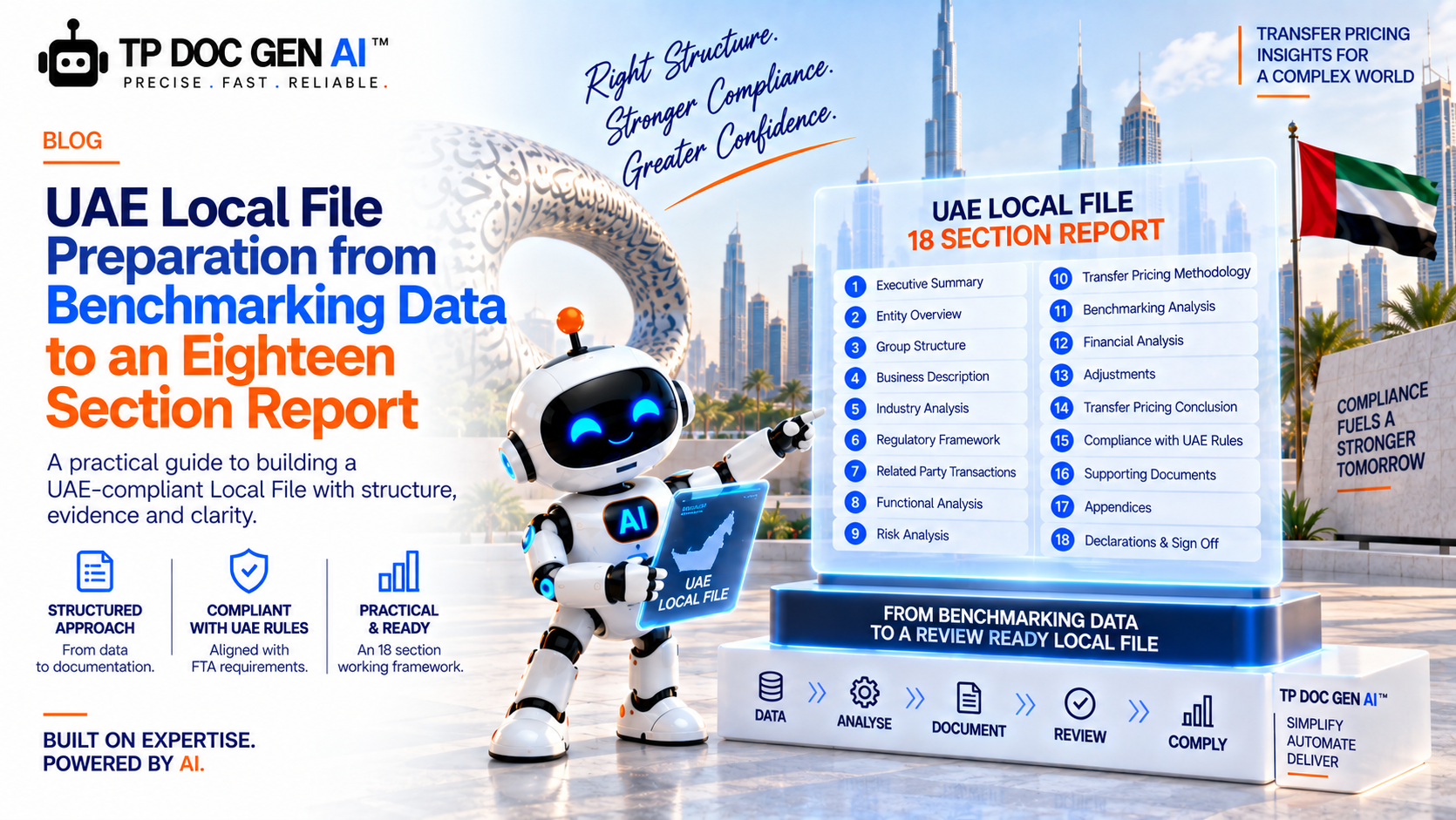
UAE Local File Preparation from Benchmarking Data to an Eighteen Section Report
Learn how to turn UAE transfer pricing benchmarking data into a structured, review-ready Local File. This practical guide covers transaction analysis, FAR, benchmarking, financial reconciliation, evidence controls and the role of TP DOC GEN AI in streamlining documentation.
Documentation 13 Sept 2026 12 min read
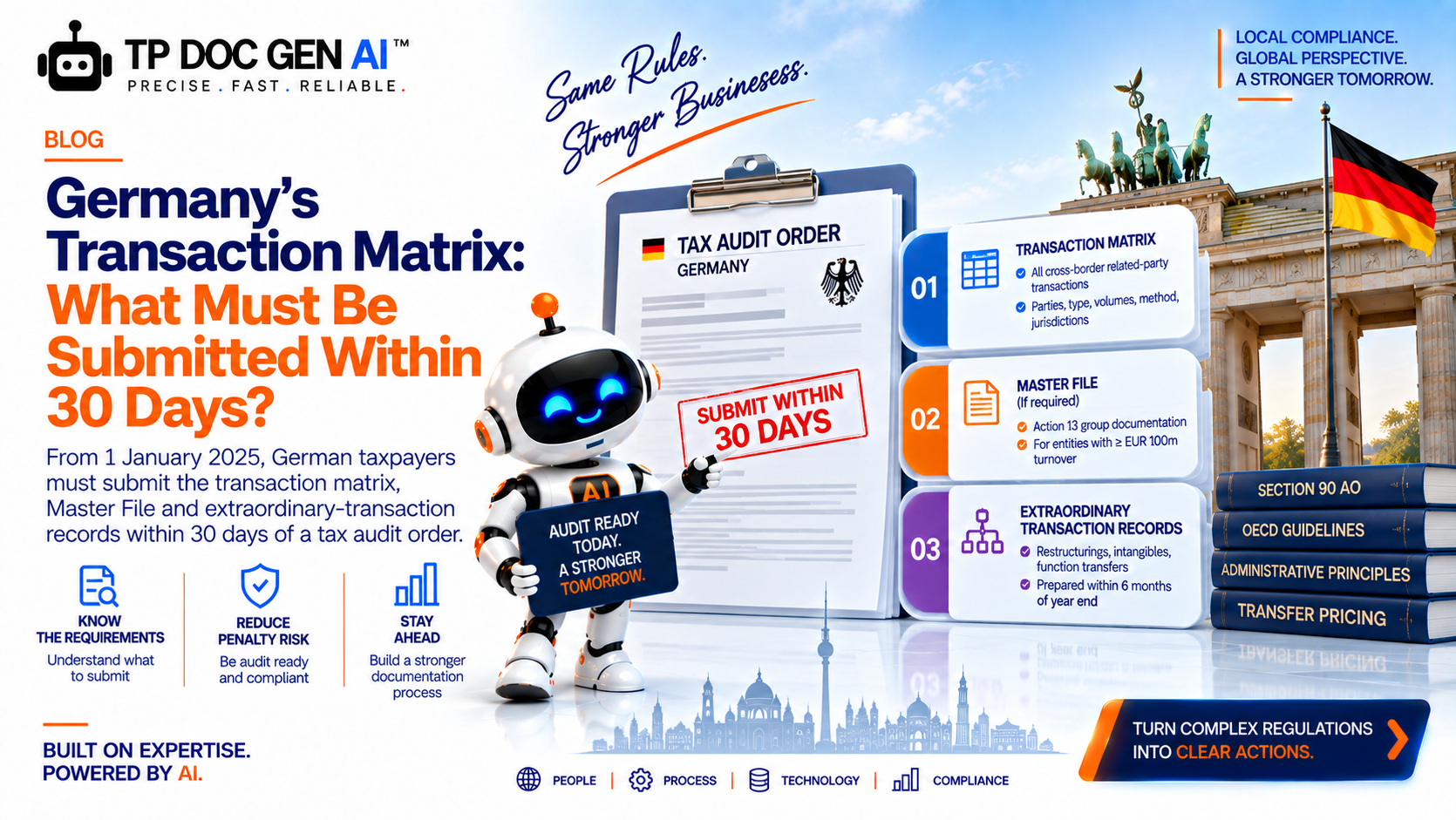
Germany Transaction Matrix: 30-Day Requirements
From 2025, German taxpayers must submit the transaction matrix, Master File and extraordinary-transaction records within 30 days of a tax audit order - .
Documentation 13 Sept 2026 12 min read
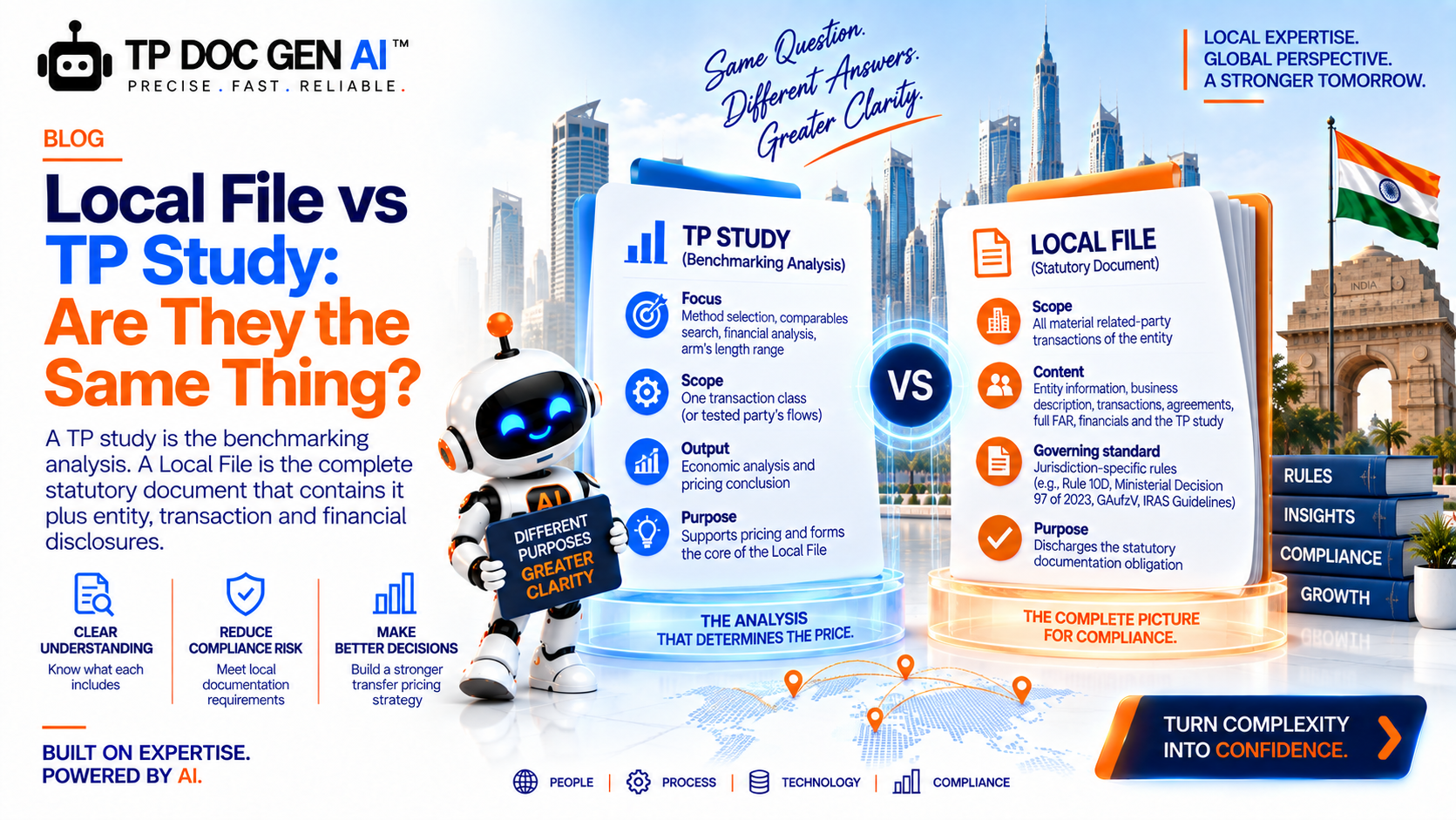
Local File vs TP Study: Are They the Same Thing?
A TP study is the benchmarking analysis; a Local File is the full statutory document that contains it plus entity, transaction and financial disclosures..