
Regulation
Connected Persons under UAE Corporate Tax: Article 36
CA Mithilesh Reddy
13 Sept 2026 · 15 min read

Direct answer
Under Article 36 of the UAE Corporate Tax Law, a payment or benefit provided by a taxable person to a Connected Person is deductible only to the extent that it corresponds with the market value of the service or benefit and is incurred wholly and exclusively for the taxable person’s business. Connected Persons generally include owners, directors, officers and their related parties, subject to the statutory definitions and exclusions.
The two tests are cumulative. A payment can be at market value but still non-deductible if it lacks a business purpose; it can also serve the business but be deductible only up to market value.
Key takeaways
- Article 36 is a specific deduction rule for payments or benefits to Connected Persons.
- The analysis starts by identifying the recipient’s legal and factual relationship with the taxable person.
- The taxpayer must support both market value and the wholly-and-exclusively business test.
- Job title alone is not decisive. The FTA’s 2026 public clarification explains that a director occupies a board or equivalent governing-body role, while an officer has ultimate strategic or binding authority over the entity’s affairs.
- A natural person may be a director or officer; an entity itself is not a director or officer for this purpose.
- When a person is both a Related Party and a Connected Person, the Corporate Tax Law treats the person as a Related Party for the relevant application, according to the FTA clarification.
- Corporate Tax return disclosure is separate from deductibility. Current return instructions and thresholds must be reviewed for the relevant tax period.
Why do the Connected Person rules exist?
Owners and senior decision-makers may influence how a business pays salary, bonus, management fees, rent, interest or other benefits. The Connected Person rules protect the UAE tax base by limiting deductions to an arm’s-length market value and requiring a genuine business purpose. They complement the general transfer pricing provisions for Related Parties.
The statutory starting point is the Federal Decree-Law No. 47 of 2022 on the Taxation of Corporations and Businesses, as amended. Article 36 should be read with Article 34’s arm’s-length principle, Article 35’s Related Party definition, the general deduction rules and current FTA guidance. The FTA Corporate Tax legislation page should be checked for amendments and implementing decisions.
The rule is not a blanket denial. A commercially reasonable salary for a working owner, a market rent for business premises or an evidence-backed director fee may be deductible. The taxpayer must demonstrate the service, business purpose and price.
Who is a Connected Person?
Article 36 broadly connects a person with a taxable person through ownership, governance or relationship to those individuals. The statutory definition and exceptions should be applied to the actual legal form and facts. Common categories include:
- an owner of the taxable person;
- a director or officer of the taxable person;
- a Related Party of such owner, director or officer; and
- in a partnership context, partners and their Related Parties as addressed by the law.
An owner is generally relevant where the person directly or indirectly owns an ownership interest in, or controls, the taxable person, subject to the detailed provision. Family and entity relationships can expand the population through the Related Party rules. A complete exercise therefore needs an ownership chart, board and authority records, related-party declarations and the general-ledger vendor and employee population.
The label used in payroll or a visa document is not sufficient. The FTA’s Public Clarification CTP010 on directors and officers focuses on substance:
- a director is a natural person appointed to a board of directors or an equivalent governing body, regardless of title; and
- an officer is a natural person entrusted with ultimate authority to make strategic or legally binding decisions concerning the entity’s affairs as a whole.
An officer may include a chief executive officer, general manager, chief financial officer, chief operating officer or chief compliance officer when the actual authority meets the test. A title does not automatically make the holder an officer, and a person with equivalent authority may be an officer even without a conventional C-suite title.
How do Article 34 and Article 36 interact?
Article 34 establishes the arm’s-length principle for transactions or arrangements between Related Parties. Article 36 specifically limits deductions for payments or benefits to Connected Persons. The categories can overlap.
The FTA clarification explains that where a person is both a Related Party and a Connected Person, the person is treated as a Related Party rather than a Connected Person for purposes of the Corporate Tax Law. This classification should be documented because it can affect how the return and supporting analysis are prepared. The underlying need to demonstrate an arm’s-length amount and business basis remains important.
A practical classification sequence is:
1. Identify the recipient and beneficial recipient.
2. Test whether the recipient is a Related Party under Article 35.
3. Test whether the recipient is a Connected Person under Article 36.
4. Apply the FTA guidance where both categories overlap.
5. Identify any statutory exception.
6. Map the item to the return disclosure and documentation requirements.
Do not classify solely from an accounting vendor code. Salary may be paid to an individual, while a management fee is invoiced by an entity owned by that individual. Both arrangements require their own legal and factual analysis.
What is the market-value test?
The deductible amount cannot exceed the market value of the service or benefit. Article 36 refers back to the arm’s-length standard. The taxpayer should consider the methods in Article 34 and the transfer pricing framework in the FTA’s Corporate Tax Guides and References.
The analysis depends on the transaction:
| Payment or benefit | Possible evidence of market value |
|---|---|
| Salary or bonus | Role description, authority, experience, time, performance criteria, independent compensation data and internal comparables |
| Director fee | Board responsibilities, meeting workload, liability, committee role and fees paid by comparable businesses |
| Management or consultancy service | Scope, deliverables, hours, cost base, benefit, comparable rates and absence of duplication |
| Rent | Property details, location, condition, lease terms, valuation and third-party rental evidence |
| Loan interest | Currency, term, credit profile, security, covenants, purpose and comparable financing terms |
| Guarantee fee | Amount, term, borrower credit, benefit, expected loss and third-party evidence |
| Asset purchase or sale | Independent valuation, condition, rights transferred and comparable market transactions |
No one method is always correct. A comparable uncontrolled price may work for property rent or a standard professional service. A cost-plus approach may suit a genuine service with a reliable cost base. A valuation may be needed for an asset or unique right. Compensation benchmarking should compare roles with similar authority, scale and geography rather than job title alone.
Market value is not necessarily the amount approved by shareholders or shown in an employment contract. Approval is evidence that an arrangement exists, not proof of arm’s-length price. Conversely, a high payment is not automatically excessive when the individual performs a commercially critical role; the file should explain the facts and evidence.
What is the wholly-and-exclusively business test?
The payment or benefit must be incurred wholly and exclusively for the taxable person’s business. The taxpayer should show what was received, why the business needed it and how the expenditure relates to earning taxable income or operating the business.
For services, retain deliverables, meeting records, correspondence, time information and evidence of decisions or outcomes. Generic invoices stating “management services” are weak. For remuneration, maintain an employment or service agreement, role profile, performance criteria and proof that the person performed the role. For rent, identify the business use of the premises. For loans, document use of funds.
Private or shareholder expenditure should not be relabelled as business cost. Examples requiring scrutiny include personal travel, family benefits, private accommodation, non-business vehicles, shareholder oversight that does not benefit the taxable person, and duplicate services already performed by employees or another group company.
The test also affects mixed-purpose expenditure. If a benefit has both business and private elements, the taxpayer should identify a reasonable allocation and determine whether the law permits the business element. Records should be contemporaneous rather than reconstructed after an FTA query.
Are there exceptions?
Article 36 contains exceptions, including circumstances involving a taxable person whose shares are traded on a recognised stock exchange and a taxable person subject to the regulatory oversight of a competent authority, together with any other cases prescribed by decision. The wording and application should be verified against the current law and decisions.
An exception from the Connected Person provision does not create an unrestricted deduction. The general deduction rules, Related Party provisions where applicable and accounting evidence continue to matter. Document the legal basis for the exception rather than omitting the person from the review without explanation.
What must be disclosed in the Corporate Tax return?
The UAE Corporate Tax return contains schedules for Related Party and Connected Person transactions. Current FTA return instructions have used transaction-value thresholds to determine detailed disclosure, including an aggregate threshold for Connected Person payments or benefits and person-level reporting. The FTA Corporate Tax Returns Guide should be consulted for the tax period and return version in question.
Practitioners commonly refer to an aggregate AED 500,000 threshold for Connected Person payments or benefits, with detailed disclosure for a Connected Person whose aggregate benefits exceed the person-level amount specified in the return instructions. Because the return, guide and digital fields can be updated, do not hard-code this figure into a permanent policy without a period-specific verification. Deductibility under Article 36 applies independently of whether a detailed disclosure threshold is crossed.
The preparation file should reconcile the disclosed population to payroll, expense ledgers, accounts payable, fixed-asset transactions, financing schedules and owner current accounts. Gross value, not merely the deductible amount, may be relevant to a disclosure test under the instructions. Confirm whether VAT, reimbursements and non-cash benefits are included for the relevant field.
A practical Connected Person workflow
Step 1: Build the population
Collect the legal ownership chart, shareholder register, board list, delegated-authority matrix, organisation chart and related-party declarations. Include persons with actual strategic or binding authority. Extend the population to Related Parties of owners, directors and officers as the law requires.
Step 2: Extract transactions and benefits
Search payroll, bonuses, directors’ fees, vendor payments, rent, loans, guarantees, asset transfers, expense reimbursements and non-cash benefits. Reconcile the extracted total to the general ledger and tax computation.
Step 3: Classify the legal relationship
For each recipient, document Related Party status, Connected Person status, overlap treatment and any exception. Record the effective dates because ownership and authority can change during a tax period.
Step 4: Test business purpose
Identify the service or benefit received, its connection to the business and evidence of performance. Remove or allocate private, shareholder and duplicate expenditure where required.
Step 5: Test market value
Select the most appropriate method, gather internal or external comparables, make justified adjustments and calculate a range or point. Compare actual payment with supportable market value.
Step 6: Determine the deduction
Limit the deduction to the lower amount supported by market value and the business-purpose analysis, subject to applicable law. Record any add-back in the tax computation.
Step 7: Complete disclosure and retain evidence
Apply the current return instructions, reconcile schedules and obtain approvals. Preserve agreements, benchmarks, calculations, invoices, deliverables and the legal classification memorandum.
Illustrative examples
Working shareholder salary
A shareholder owns 40% of a consulting company and serves as chief executive. The company pays AED 1.8 million. The role is real and business-related, but the deduction still requires market-value support. The analysis should consider the company’s revenue, employee count, geography, authority, experience, performance and independent compensation evidence. If market value is AED 1.4 million, the excess may be non-deductible even though shareholders approved it.
Director’s private travel
A company pays for a director’s family holiday and records it as business development. There are no meetings, agenda or business deliverables. The expenditure fails the business-purpose test regardless of whether the travel price was market rate.
Premises rented from an owner
A company rents an office owned by its majority shareholder. The space is used wholly for the business. Independent listings and a valuation support rent of AED 600,000, while the company pays AED 850,000. Article 36 analysis would generally focus on limiting the deduction to the supportable market value, subject to all facts and law.
CFO classification
A finance head carries the title CFO but can approve only routine payments and cannot make strategic or legally binding decisions for the entity as a whole. The title alone does not settle officer status. Review the board delegation, signing authority and actual conduct. A different finance executive without the title may qualify if that person exercises ultimate authority.
Documentation that withstands review
A concise Connected Person file should contain:
- legal basis and relationship classification;
- ownership, board and authority evidence;
- complete transaction and benefit schedule;
- agreement and contemporaneous business-purpose evidence;
- method-selection memorandum;
- comparable search, compensation survey or valuation;
- calculation of market value and deductible amount;
- tax-computation adjustment;
- return-disclosure reconciliation; and
- reviewer and management approvals.
The file should avoid generic statements such as “services were necessary” or “salary is industry standard.” Identify the service, person, period, value and evidence. If the support is unavailable, the uncertainty should be escalated rather than hidden by polished narrative.
How TP DOC GEN AI can support the process
TP DOC GEN AI can help a tax team organise relationships, transaction facts, supporting documents and transfer pricing analysis. Its features include Local File generation, AI-assisted benchmarking, a benchmarking repository, multiple profit-level indicators, translation, foreign-exchange support and a global compliance calendar. Its methodology separates AI-supported narrative drafting from deterministic calculations and maintains human review before export.
For Connected Person work, a structured workflow can capture ownership and authority, classify the transaction, collect business-purpose evidence, maintain benchmarking and produce a reviewable narrative. The system should not decide legal status from a job title, invent service evidence or assume that a payment is deductible. The taxpayer and its advisers remain responsible for classification, method, market value, add-back and filing.
Before uploading contracts, remuneration or ownership data, review the platform’s security approach and the organisation’s own privacy and access policies. Demonstrations should use anonymised data, and production roles should follow need-to-know access.
Next step
To explore a structured workflow for relationship mapping, evidence, benchmarking and documentation, book a personalised TP DOC GEN AI demo using anonymised Connected Person scenarios relevant to your business.
Disclaimer: This article is general information and not tax, legal or accounting advice. UAE Corporate Tax law, decisions, guidance, return fields and thresholds may change. Confirm the current official requirements and specific facts before claiming a deduction or filing a return.
Frequently asked questions
Who is a Connected Person under UAE Corporate Tax?
Connected Persons broadly include owners, directors, officers and Related Parties of those persons, subject to Article 36’s detailed definitions, overlap treatment and exceptions.
Is every payment to an owner disallowed?
No. A payment may be deductible to the extent it reflects market value and is incurred wholly and exclusively for the taxable person’s business.
Are market value and business purpose separate tests?
Yes. Both must be satisfied. A market-priced personal benefit can fail the business-purpose test; a genuine business service can be deductible only up to market value.
Is every CFO an officer?
No. The FTA says the title is not conclusive. Review whether the person has ultimate strategic or legally binding authority over the entity’s affairs as a whole.
Can a company be a director or officer?
The FTA clarification describes directors and officers as natural persons for Article 36. Payments to an entity may still fall under Related Party or other provisions.
What happens when someone is both a Related Party and Connected Person?
The FTA clarification states that the person is treated as a Related Party rather than a Connected Person for the relevant application of the law. Document the classification and return treatment.
Is the Connected Person disclosure threshold AED 500,000?
Current return guidance has referred to an aggregate AED 500,000 threshold, but the applicable return and instructions must be checked for each tax period. The threshold does not determine deductibility.
How is an owner-manager salary benchmarked?
Compare the actual role, authority, experience, business scale, geography and performance with reliable independent compensation evidence. Job title alone is insufficient.
What evidence proves management services?
An agreement, defined scope, invoices, time records, deliverables, correspondence, meeting records, allocation basis and evidence that services were received and not duplicated are useful.
Can AI decide whether a person is connected?
AI can organise ownership and authority facts and flag possible relationships. Legal classification and tax treatment require professional review of the law and actual conduct.
Authoritative sources and external links
2. UAE FTA: Corporate Tax legislation
3. UAE FTA: Corporate Tax Guides and References
4. FTA Public Clarification CTP010: Director and officer
5. UAE FTA: Corporate Tax Returns Guide
6. UAE FTA: Corporate Tax FAQs
More on Regulation

Regulation 13 Sept 2026 16 min read
UAE Free Zone Transfer Pricing: QFZP Guide
Learn how transfer pricing affects UAE Qualifying Free Zone Persons, qualifying income, de minimis limits, substance, documentation and controls.

Regulation 13 Sept 2026 16 min read
India Safe Harbour Rules 2026: Rates vs APA
Understand India’s transfer pricing safe harbour rates, eligibility, compliance steps and when an APA may provide better long-term certainty.
Regulation 13 Sept 2026 12 min read
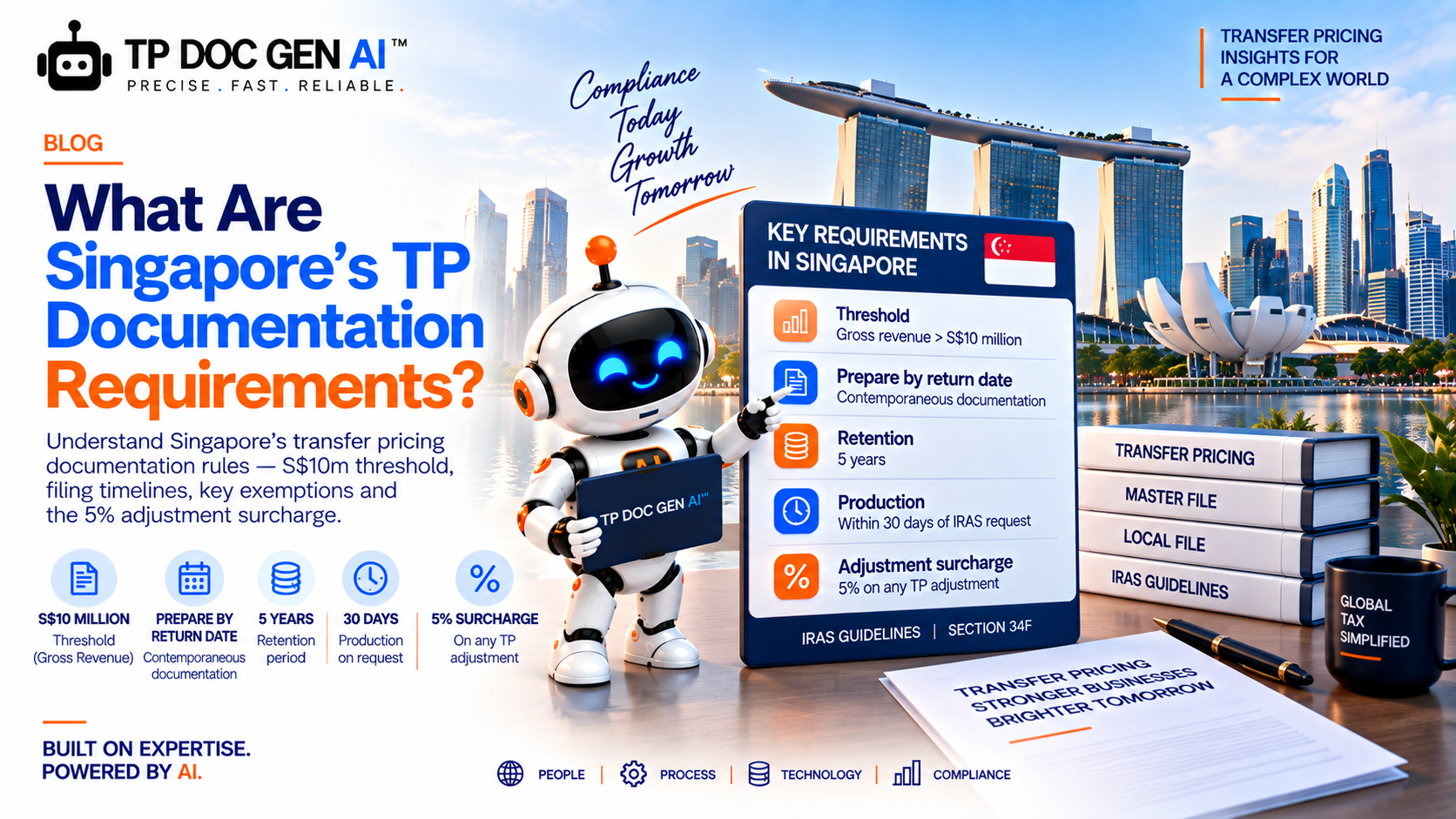
What Are Singapore's TP Documentation Requirements?
Singapore requires TP documentation under Section 34F above S$10m gross revenue - prepared by the return date, kept 5 years, produced in 30 days, with a 5%.